Saturday, February 19, 2011

V&A opens Architectural Gallery

The V &A has opened a new Architectural Gallery in the Museum. For now its exhibits come across as a collage of different things with no apparent narrative. 
As much as it looks rather accidental, to see a model of Bramante's Tempietto, next to Grimshaw's Eden Garden Dome design, that is next to Arup's Structural analysis model, one wonders if the V&A curators ambitiously desired to map the 'progress' of architecture or did they desire to come up with some kind of explanation for our current state of confusion
But given the richness of every individual exhibit, the gallery is worth a visit as long as the visitor takes a deep breathe and a conscious 10 second break between seeing an exquisitely detailed hand drawn axonometric of St Paul's and laser cut 20 option-models of Foster's Gherkin.
(all photos in the post, photo courtesy of Nora)

Monday, February 14, 2011

Voynich Manuscript

I have written before small, odd, confused articles on language (1, 2, 34) and other speculations associated, one of which being erasure of language. To speculate on possibility of losing the memory of sounds and symbols that make up words and how to arrange these together. Being able to imagine an alternative history where Rosetta stone was never discovered and we are left with only encoded unrecognisable vast archives that look exquisitely rich in their meaning but undecipherable,quite similar to the symbol of human infertility, where Zizek talks about Art in the absence of its context in Children of Men.
I can only imagine the feeling cryptographers, ciphers, linguists and historians get when they study The Beinecke MS 408 or also popularly known as the Voynich manuscripts presently housed in Yale University's Beinecke Rare Book and Manuscript Library building (designed by SOM). A treasure trove of history, symbols and science locked up meaningless without its codec. Some images below for visual intrigue and pleasure.
(All images for this post have been borrowed from the Beinecke Rare Book and Manuscript online Archive, Yale University.)

Friday, January 28, 2011

La Vie Aquatique

(The text below is not a description of London aquarium, but it was inspired by a recent visit to it)

(image of the Crystal Palace Aquarium sourced from here.)
Though designed by a name obscured by time and tides, the aquarium could be considered to be a dream project of curiosities, entertainment and science, set within the Victorian era that bravely peered into the oceans' depths. Oceans that unlike today's still nurtured within them the myths of mermaids, sea monsters,loch ness and science of species in equal proportions. The aquarium was indeed a small sample of this vast primordial soup of life that had abilities to shelter myth and science simultaneously, to be viewed and awed by the public, a television set of the 19th century!

And so the stone facade of the aquarium building was an alto relievo jigsaw of two intertwining narratives, one of the oceans created and the other of the oceans formed. The Darwinian narrative covering the plinths of the building with relief work of smaller more intricate Crustaceans, Mollusks and Echinoderms that could be observed and displayed at human height, flowed along the stormy biblical waves of Philip Gosse as species got simultaneously created and evolved, with whales, squids and sharks forming support system for the rusting copper roof and sea monsters occupying the place of gargoyles that poured water out into various crevices of the facade to bring the oceans to life on a rainy day.

(Statue of Poseidon. Found on Milos with the statue of Amphitrite. In his raised right hand he will have held the trident. Next to his right leg is a support of in the form of a dolphin. 125-100 BC . National Archaeological Museum of Athens, sourced from http://www.greek-thesaurus.gr/hellenistic-age-marble-sculpture-statues-photo-gallery.html)
The entrance of the aquarium was a double height wooden dome with copper handrails, circular riveted portholes and other borrowings from Jules Verne's Nautilus, at the centre stood a six metre high black granite statue of Poseidon, whose beard, hair and cloth seemed to turn the air around into water. A recent material analysis had confirmed the stone came from the submerged monument of Yonaguni Jima, Japan. Our tickets came bundled up in mermaid's purse, an object that just like the facade embodied within it echoes of myths and science alike.

(image of Ascidiae plate 85 from Kunstformen der Natur by Earnst Haeckel, sourced from here)
The first chamber was a gallery of original paintings by Earnst Haeckel, letters exchanged between Robert Warington and Gosse, a manuscript by Jules Verne's recently discovered book 'The seas of Neptune' by a great grand daughter of his editor Jules Hetzel, a fifteenth century Latin translation of Plato's Timaeus and Critias and lastly a final piece of this puzzle Alastair Pilkington and Kenneth Bickerstaff, the men who made the Crystal Palaces, and aquariums possible for the Victorians, the men who made glass visible or should i say invisible! In this room the life aquatic, science, art and most importantly men seemed to evolve and achieve greatness that challenge the world as we know it.

(Cover of "L'Algerie" Magazine, 15 June 1884, image from wikipedia article on Jules Verne)
The visitors could travel through a series of chambers. Each chamber had two identical doors, faith and fact, objectivity and subjectivity, etc and through the selection of each door the aquarium revealed itself as a labyrinth of multiple choices that single cell plankton to multi cell complex organisms had to make as they evolved newer appendages for their faiths or shed older organs to well known facts, thus contributing to the success of their future generations and building on the strengths of the past. The displays were a part of the labyrinth influencing the visitors' choices, presenting themselves as part fact part fiction, like the sea anemone that forms gardens of living tissue along coral reefs or the sleeping whale that formed an island in the first voyage of Sindabad. This Labyrinth had multiple glass stairs and corridors leading up or down between display rooms; these being completely made of glass were the only spaces from where one could peer out at the labyrinth, see silhouettes of other people moving and be conscious of its massive scale and complexity. Peering out of these glass spaces, sometimes littered with objects of everyday use, spoons, tables, books, toys, etc the visitor realises he too like the fishes is a part of this aquarium, not a visitor, not a witness but an active organism that has influenced the labyrinth of evolution through the choices made and an inseparable display like the rest.

At the end of the journey the visitors who had travelled each his unique distance and observed a unique set of sea creatures, all converged into a common egg shaped chamber which was newly added annexe to the aquarium building. This chamber unlike the others was an iridescent, seamless opaque space lit by fluorescent white light. The centre of the space had a six metre high white marble statue of Oceanus rumoured to be made from Golgotha stone. The statue was said to had been recently acquired by the aquarium with its origins traced to a Renaissance genius working in Florence around the beginning of sixteenth century. The display tank was located along the equatorial line of the geoid. A robotic arm above the tanks whizzed and dropped in creatures announcing ticket numbers corresponding to each creature. These were chimeras, being printed for each visitor based on the visitors journey and his choices. Some were grotesque nebular lumps of flesh where the choices of fact and fiction had made the organism incapable of living, some exquisitely beautiful where the two dialectics had stabilised in cohesive harmony. Due to Global genetic laws, the life span of these fantastic creatures created by man was to be only few minutes till they formed the display and had been seen by their creator. But so unique and powerful would be the relationship of this creature to the visitor who created it through his/her choices, that the image would form a part of the visitors sub conscious, influencing decisions for rest of his/her life. This was a consistent effect seen on all visitors who visited the aquarium. Some controversial psychoanalysts had gone to the extent of calling it a Lacanian mirror stage of the entire species, some pointed that we had discovered the Omphalos, the ultimate allegory of the creator allowing the creations to create.

(Double plate illustration showing embryos of fish (F), salamander (A), tur tle (T), chick (H), pig (S), cow (R), rabbit (K), and human (M), at "very early", "somewhat later" and "still later" stages, from Haeckel's Anthropogenie published in 1874, image sourced from here)
And so the visit to the aquarium in the 21st century had come to be a Hajj for the entire human race, balanced between scientific exploration and spirituality. Thus the aquarium, the least expected institution of Victorian curiosity and intrigue had come to negotiate differences between subjectivity and objectivity, between the church and the parliament, between inquisitions and justice. Like fishes aligning themselves to light in the absence of gravity, mankind was aligning itself to the sea within.

Sunday, November 14, 2010

Collective Lost&Found Libraries and Insertions in Ideological Circuits

When I lost a very good book few months back I remember one of my friends telling me not to grieve over it as it had only become one of the many articles that form a collective pool of lost objects and something had become little more public in a world infested with privatising even thoughts and ideas. For me it was nice to imagine a city where people would be conscious of these lost and found objects, where as a gesture one had to leave an 'exchange' for the object they wish to take with them only to be lost again when they desire. Or seeding a city with books purposefully lost along strategic locations on designed topics to be found by an unsuspecting audience member, could very well come to be a tool of revolution, atleast a literary one, maybe.

(one of the works of Cildo Meireles, with the question "Who killed Herzog?" stamped, refering to the suspicious death in prison of the journalist Wladimir Herzog sourced from TATE also a very good interview of the artist here)
One of the artists whose work I really enjoyed seeing at Tate Modern, Cildo Meireles believes in using pre-existing systems to ones advantage which he refers to as Insertions into Ideological Circuits. Where objects of daily use that get circulated through a huge number of people (currency, soft drink bottles, or maybe even the London tube free newspaper) can be appropriated to send messages to a far diverse and wider audience. In an interview the artist explains "While having a beer with a friend at a bar in Rio, he remarked that an olive stone could never be removed from a bottle unless the mechanical process for washing bottles was changed. As I pictured this olive stone inside a bottle, I concluded that there are circulation mechanisms within society which could be used by artists as counter-information. Newspapers, radio and television are circuits for transmission with a very broad reach, yet they are vulnerable – that is to say, they are easily controllable."
Another artist whose work comes close to this is Omer Fast whose work T3-Aeon involved altering the soundtrack of The Terminator movies rented from New York area video stores. The sound tracks were interviews that served as a secret anonymous record of incidences that had transpired in the private space. Like Michel Gondry's Hollywood comedy Be Kind Rewind the possibilities of remaking stories and inserting them within this system is infinite.

(image sourced from the artist's blog here)

(image sourced from the artist's blog here more images can be found here)
In present day digital age, while the corporate thugs go on a witch hunt to close down different services that allow free exchange of files that are private properties, I came across the DeadDrops project by Aram Bartholl! It is fantastically smart move in the present context, goes along the lines of juxtaposing two public spaces together and just plays along the "what is in the box" curiosity for people to start plugging in along walls, booths, curbs and all sorts of places to exchange files that they have no clue of. And yes there is always fear of catching viruses but that is true for even delicious looking street food! its public space so get over it!

Sunday, November 07, 2010

1st para: found a nice blog, 2nd para: a long painful rant, 3rd para: Happy Diwali

Of the different kinds of architectural drawings made during different stages of the project, there are two types that almost tend to sit on either side of the process establishing a dialectics. One conceptualising architecture as a form of knowledge while the other casting it as knowledge of form. To me it is the conceptual stage that is most intriguing, during which architecture formulates itself as a built indicator/critique of various socio-political and environmental trends. Sometimes the drawing that conceptualises the product is so exquisite that the built project is read as a representation of that drawing.

(borrowed from Nikita's blog Drawing Architecture, one of the many drawings found on her tumblr site. Above is drawing by Ivan Leonidov for Ministry of Heavy Industry)
If you too like me enjoy seeing these kind of conceptual drawings then I found a very nice tumblr blog maintained by Nikita a student of Architecture with a keen eye for good drawings, skilled doodler and with great sources for some really beautiful drawings that are not easily available on the net. Added to my sidebar under depositories, I hope she continues sharing some great drawings.

But if you are more into "i like getting things built and done man" (in the manner of a pass out with zero imagination and trying to earn some redemption through picking up some fairly conventional standard details from ridiculously predictable sources like your employer or worse, books recommended by your builder) then go read some Neuferts and hope that someday the house you build will have fantastically standard details that will work but will just be another standard house in the village and not Villa Savoy.


(sourced from Ghee Happy)
In order to end this post on a better note, now for something completely different, Wishing everyone A Very Happy Diwali!

Saturday, October 30, 2010

Mapping

"If we were able to take as the finest allegory of simulation the Borges tale where the cartographers of the Empire draw up a map so detailed that it ends up exactly covering the territory (but where the decline of the Empire sees this map become frayed and finally ruined, a few shreds still discernible in the deserts — the metaphysical beauty of this ruined abstraction, bearing witness to an Imperial pride and rotting like a carcass, returning to the substance of the soil, rather as an aging double ends up being confused with the real thing) — then this fable has come full circle for us, and now has nothing but the discrete charm of second-order simulacra."
Jean Baudrillard, "The Precession of Simulacra"

Sunday, October 17, 2010

To Learners of New Languages and Old

According to Foucault, the relationship between thought and language is that of geometry and algebra, where all the geometric shapes spontaneously pre-exist in nature waiting to be drawn and discovered but it is the algebric expression that provides the shape a meaning that is precise to its nature, where the spontaneity of the shapes' existence gets tuned in a mathematical meaning that when played will become that shape. And sometimes it is formulation of an algebric expression that could lead us to an undiscovered shape.
I loved this metaphor as it immediately makes one conscious of the proximity of language to space and social structure.This simultaneous Independence and symbiotic interdependence between language and thought I believe makes it even more crucial to conserve, learn, understand, speak and make new languages or else we lose out on all hopes of making something truly original that sprouts from the fertile soil of human conscience.
Some linguists estimate that a language dies every two weeks with the death of its last speaker. Apparently India tops the list with 196 endangered languages, geographically most of them located in the North and North-Eastern regions which had an interface with rest of the Asian landmass.
Maybe some decades down we may come to inherit a handful of fine words distilled to perfection by the utilitarian global culture, that quite ironic for their meaning sum up the true essence of human rot: LOL & LMAO!

Monday, September 27, 2010

Photography of Time Travel


(the white lines in the sky are a result of the sun moving across the sky and variations in the sun path through the year. photograph sourced from here)
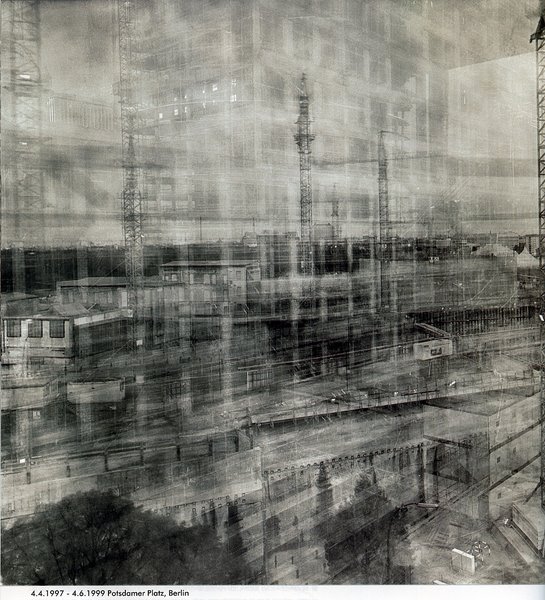
Recently I came across German photographer/artist Michael Wesley's monochromatic photographs that are a part of his open shutter project, which record the image over long periods of exposure sometimes lasting 3 years.
In the past I have also written of Michael Kenna's long exposure photographs in low light conditions giving absolutely stunning high contrast images that beautify the very constraint, the static nature of a photograph. Here the image isnt a split second capture but something that has been and will continue to be. The environments recorded are almost meditative minimal landscapes of silence.

(image sourced from here)
But when a similar methodology gets used in urban environments that attempts to record months of moving images in one frame the result is as magical. Within the greater Order of Things in the branch of still photography I believe it is like discovering dialectically opposite twins.

(image sourced from here)
Michael Wesley's monochrome photographs that continue capturing the image over a period of 2 to 3 years constantly as the glass eye of the camera gazes continuously at one focus and the world around it changes, it instantly transforms into a time machine with its precise control over the speed of light, absorbtion of the memory of the past, experience of the present and dreams of the future on the film. The images thus recorded are as magical as the moving pictures, they record the very ghosts of time, the paths of the sun as it speeds across the horizon, the glare of a glass window on a particuilar day in winter.

(image sourced from here)
I wonder what would it be to have a camera positioned whose exposure time will work through generations, what would one like to focus their eyes on for the next 80 years if they know it will only be their next generation that shall see what it looked like.

Saturday, September 25, 2010

London Open House


(Roger's Channel 4 building)

(Roger's Maggie centre, small and very beautiful building as opposed to the channel 4 building.)
The London Open House is one of a kind architectural event that celebrates the city and its endeavours in articulating its built environment. Inspite of being architectural it seems to work at an urban scale as the entire city is turned into a gallery / museum exhibiting different buildings of architectural importance with people walking, running, cycling and in case of lazier ones like me taking the tube between different buildings of their choice that are made open to public over this open house weekend.

(Building to the left with circular windows and hideously out of scale pattern is FOA design and next to it sit buildings by generic practices that decided to 'design elevations based on copy, paste and array commands in autocad' according to my fellow architectural photographer for the day Dominyka Togonidze)
The buildings vary in scale, typology, date of design and conception. The entire process of careful selection of buildings that intrigue you the most out of a list of 800 and imprinting them on the London map with a game plan based on your preferred order of tastes in the course of this architectural buffet and the desire to savour everything laid out on the table makes it a truly urban experience. This year we covered the Greenwich Yatch Club, Maggie's Centre designed by Richard Rogers & partners. Another building that we visited was Roger's Television Channel 4 building which again wasn't open on that particular day of the open house.

(some really interesting designs by Adjaye associates. All photos in this post including these are courtesy of Dominyka Togonidze)
Also visited two buildings by Adjaye Associates in Shoreditch which were the Rivington Place and Dirty house unfortunately both not listed on the open house this year. Both the buildings are black and very minimal with some interesting details, formal strategies and material palette. I think Adjaye's is one of the few new practices that we can look forward to for more interesting work.
On the whole it was a great day filled with
archi- conversations, arguments and gossips while we went on a treasure hunt building to building collecting elements, details, materials, form and colours in our minds to be put to use in fantastically improvised versions when the time/project comes!

Saturday, September 11, 2010

Concrete Flower to Death

In the Park of Eternal Glory next to the Wall of Memory rests a white concrete building to Death. The Kiev Crematorium designed by Architect Avraham Miletsky in the year 1975. The dynamic spatial sculpturing of space makes one wonder if the building is in a constant state of infinitesimally slow motion as its white concrete petals bloom and rotate producing a meditative grinding sound, while warm Death embraces the body inside.

(image sourced from here. There are also some more images here and here)

Saturday, August 14, 2010

Hiroyuki

During my early days in architecture all of us during a brief phase had taken to worshipping Tadao Ando, which secretly we still do in some obscure corner of naivety unpolluted by the realisation that it cannot be that simple, life is far more complicated, filled with contradictions that need to be represented in our spaces, objects, skews and corners. Ando had been popular for quite sometime then but it was during my first year in Architecture that he built Church of the Light a building that worshipped space, made concrete an inch more beautiful than what the modernist had left it as and we drooled.

It is this rich simplicity that draws me to Hiroyuki's work of which I have written before.
Hiroyuki will be exhibiting three new pieces in his next show at Art Sites, a gallery in Riverhead, NY. If you are the lucky few around do visit...I personally would like to see the scale of these objects...and if they open up like loosely held 3d jigsaw puzzles, or do they crack like egg shells, are they hollow or filled with a heavy fluid, is there a temperature difference in the blacks and whites, browns and greys...I guess I will definitely be banned from entering the gallery or his workshop!
I hope the art work sells and and pray definitely not to clients who would use it as bourgeoisie conversational props with their boring guests in plush living rooms with matching minimal aesthetics.

Sunday, August 01, 2010

Surreal House & the Third Manifesto

For surrealists and people who love them, the Barbican's Surreal House is an exhibition you wouldn't want to miss. The exhibition is a collage of artists, filmmakers, architects and last but not the least Freud. It allows one to move around and pick and choose and relish what one desires from a buffet of anarchy, dreamscapes, metaphysics, sub conscious and pianos that hang upside down from ceilings making eerie sounds. Few rooms play short movies by the surrealists and people randomly stop by to peep in, look, maybe sit through the entire film (I couldn't help but sit through Jean Cocteau's very beautiful film La Belle et la Bete), or just leave half ways.

(one of the scenes from the movie Beauty and the Beast by Jean Cocteau)
For me personally the exhibition as well as the work displayed being able to allow the fractured pick-and-choose-help-yourself experience was very nice and only enhanced the nature of work for me. The focus stayed on the playfulness of the work as people genuinely seemed to smile, laugh and enjoy the films, sculptures and images.

(Tim Noble & Sue Websters scuplture "Metal fucking Rats" sourced from here is also a part of the show and one of my favourites)
If you are around and believe in Andre Breton and his deranged friends or just simply love Salvador Dali, Marcel Duchamp, Rene Magritte, Alberto Giacometti, Man Ray, Joseph Cornell or Louise Bourgeois then this exhibition is worth a visit, who knows you might be one of the fortunate few to come across some old pages from the draft of the third manifesto somewhere out there in the surreal house planted by one of the many living surrealists...in hopes that we may learn to dream again.
Talking of dreams, I wonder what Inception would had been, had the surrealist made it? With sleek, polished clear dreams corroded by Freudian psychoanalysis, where Joseph Cornellian objects in boxes retrieve different memories for different individuals sitting in the audience, where cities fold on itself but also cut, paste and form collages of resistance and revolt, with the audience contributing their own dreams to a narrative that unfolds like an exquisite corpse and the movie ending differently for different sittings, like Giacommetti's sculptures, Max Ernst's paintings and many other artifacts from the third manifesto. Now, that would be a good movie!

Saturday, July 24, 2010

Red


At the end of history we have two architectural caricatures the serpentine pavilion by Jean Nouvel and Anish Kapoor's ArcelorMittal Orbit (which has been very nicely covered by Martin of Kosmograd), that seem to embody fragments of Russian constructivism ironically sponsored by global capital. Instead of being monuments to the masses these are schrizophenic objects that represent the disjunction in architectural practise and its context. They neither have the sense of intrigue and adventure that Russian constructivism had nor the formal ambition of Tschumi's Parc de la Villette's Follies. We are in the process of evolving a language with no memory. And what is most intriguing is that these assemblages of red-confusion come through Jean Nouvel and Anish Kapoor who have works in their name that I personally find quite interesting.
But being red, the Serpentine Pavilion does give some good photos...

Sunday, July 18, 2010

Letters from Zihuatanejo


(photo "Rain" by Michelle Compton, UK, sourced from here)
Some years back I remember reading an excerpt from Murakami's After Dark, describing a street scene seen by one of the characters as "Even at a time like this, the street is bright enough and filled with people coming and going—people with places to go and people with no place to go; people with a purpose and people with no purpose; people trying to hold time back and people trying to urge it forward." I find the quote as beautiful as Wong Kar Wai's Chunking Express slow motion shots of Cop633 as he sips on his black coffee in the rain&people filled street of Hong Kong as the beautiful Faye Wong looks on, like Italo Calvino's Marco Polo experiencing different cities in the same city, as spatial explorations get entangled with time, memories, inhabitants and languages. For now it is summer here and happy memories, old friends and familiar places keep me company...while time passes in beautifully choreographed slow motioned shots.

Thursday, May 27, 2010

Concrete Geometries

Few weeks back Me and Kostas participated in a call for exhibition put out by the AA, called Concrete Geometries Spatial Form in Social and Aesthetic Processes.
Below is our entry which consisted of repackaging of our Master's thesis. We didn't get through, which may be one of the signs that we need to stop hamming around our thesis and find something new....I have also a put some text along which was submitted for the competition.

The world as we know it is being rapidly shaped by two major processes Globalization and Urbanization. These two processes are able to bring about social, cultural, political and physical changes within geographies that they touch . These changes in turn transform the geography into yet another specialized terrain constituent that fits within the mega mechanism of global processes, developing in trajectories different from rest of the surrounding region.

Metaphorically the form and mechanism of the Rubik’s cube allowed imagination of an object that drew parallels with this condition of transforming and shifting terrain through globalization. This was imagined to be a spatial experiment, where we could simulate conditions of symbiosis or parasitism between two or more geographies and social structures that cross path due to the turning of the Rubik’s cube. Each surface was imagined to be a city designed through Italo Calino like narratives designed based on our present conditions of existence and at the same time fractured by the rotational mechanism of the cube, that allowed for a deconstruction of these narratives similar to Calvino’s “If on a Winter’s Night a Traveller” opening up numerous possibilities of interpretation based not only on the object to be read but also on the reader, the authors and the city outside.

Each surface of the cube was to be one city, thus the 6 cities were:
1)Panopticon: The city of Surveillance
2)Heterotopia: The city of Gardens
3)Noah: The city of Archives
4)Alice: The city of Labyrinth
5)Leviathan: The city of Hierarchy
6)Celestial: Struggle against gravity

In the book “The Architecture of Deconstruction” by Mark Wigley the writer traces the architectural translation of the philosophical term deconstruction based on Heidegger’s rethinking of building in Destuktion und Abbau. Destruktion means “not destruction but precisely a de-structuring that dismantles the structural layers in the system” and Abbau means “to take apart an edifice in order to see how it is constituted or de-constituted”
With the above abstract as a prologue it is easier to clarify what the cube supposed to insinuate as form and structure. In remobilizing these terms we are trying to advocate that the cube is trying (at least) to construct first a series of contradictions between systems and forms.

Creating these crucial conditions of ambiguity each one of the cities that occupy the 6 faces of the cube they don’t remain attached as binary systems but they are subjects to external forces of un-building. Near the edges of the cube where the cities form the first inaccessible limits, each organism-community reached points of weakness, Weakness of adapting and merging with the other. So for us the process of contamination through the transformations of the Rubik’s cube is the construction of inner penetrations cracks and flaws. This is an operation that demonstrates the extent to which the structures depend on both of these flows and the way that are disguised.

The 6 cities were designed as narratives where one of the many forces that shape a city became crucial and amplified to an extent that it shaped the social and physical geography of the city. Thus the cities have been designed to a detail of a day in the life on a citizen in each of the city, witnessed by an observer who travels along all the cities that shift, collage, and re-assemble to generate parallel geographies of our global landscapes and at the same time speculative geographies that are in waiting....