Showing posts with label Photography. Show all posts

Monday, April 24, 2017

Istanbul

Bosphorus

Buyukada

Galata Tower

Hagia Sophia

Levent

Naval Museum

Topkapi Palace

Ullus Savoy / Ullus Park


Tuesday, May 06, 2014

Canterbury, Ramsgate, Broadstairs, Dover, Hastings

Trip to Canterbury, Ramsgate, Broadstairs, Dover and Hastings (3th, 4th May)
Inside Canterbury Cathedral fortification

Ramsgate Beach
Ramsgate Beach


Chalk Cliffs of Dover


Dover Cliff

Fishermen's Housing and Shops @ Hastings

Tuesday, November 19, 2013

Delhi-Mathura-Agra-Fatehpur Sikri-Abhaneri-Jaipur

Water Axis as a Landscape element in Charbaug, Delhi

Humayun's Tomb, Delhi

Courtyard of Delhi Crafts Museum

Ugrasen ki Bawli, Delhi

Chand Bawli, Abhaneri

View of Amber Fort from Nahargad, Jaipur

View of Jaipur city from Jaigad

Qutub Minar, Mehrauli, Delhi

Humayun's Tomb, Delhi

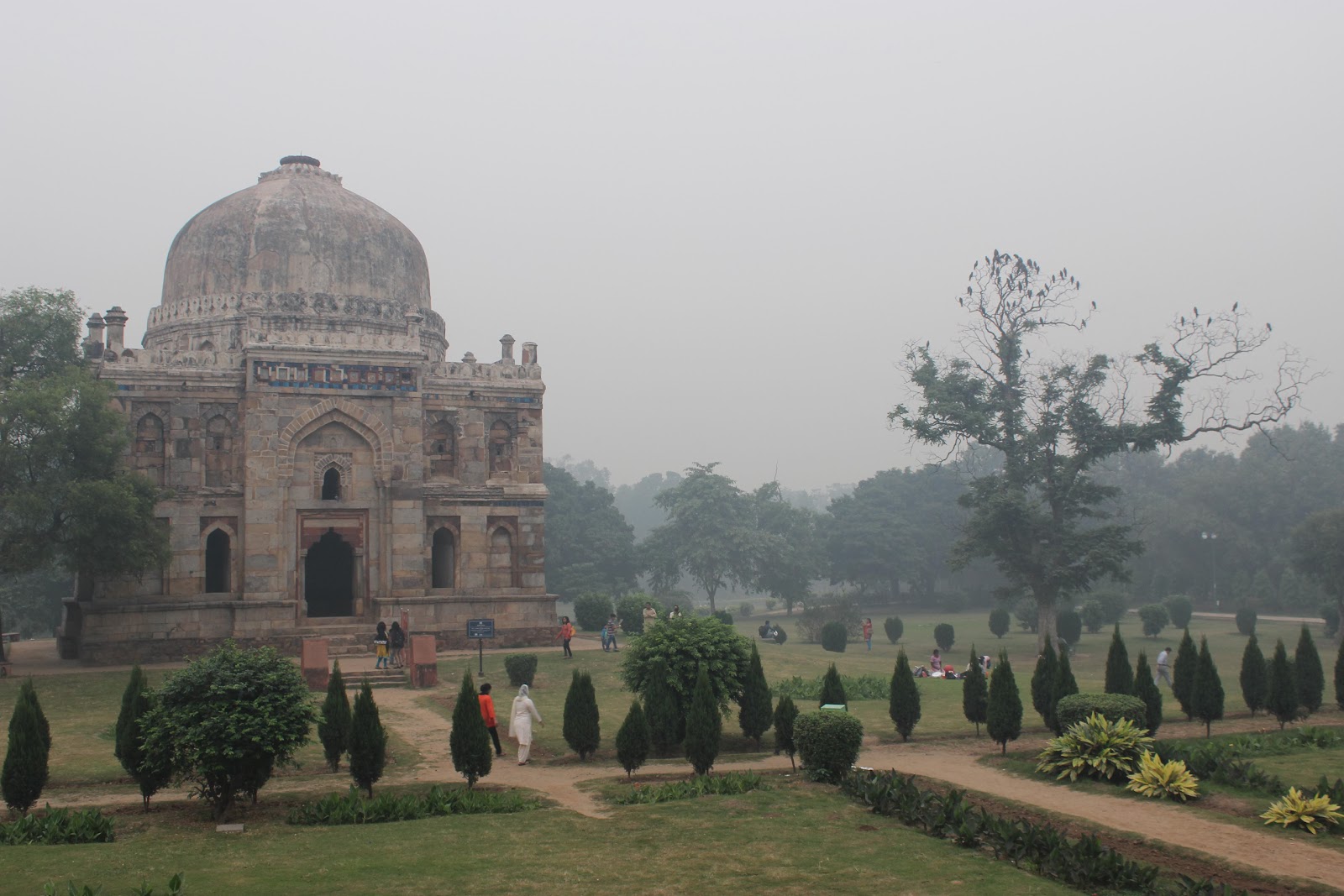
Bada Gumbhad in Lodhi Gardens, Delhi

Lotus Temple, Delhi

Oarsman at Mathura

Taj Mahal, Agra

Fatehpur Sikri

Parrots at Abhaneri

Inside Pura Quila, Delhi

Camel at Jaigad, Jaipur

Purana Quila, Delhi

Sleeping Macaques at Jaigad, Jaipur

Guard at Nahargad, Jaipur

Lodhi Gardens, Delhi

Snake Charmer at Amber Fort, Jaipur

Jal Mahal, Jaipur

Saturday, April 23, 2011

Collective Memories


(images sourced from here, which has some more of Corinne Vionnet's works)
Every monument has a postcard and every postcard has its monument that can be viewed and recognised instantly by eyes of friends and family that may never visit it. But through the circulation of these postcards across the globe, not only the monument but even the vantage point from where to record it best have become a part of some sort of a collective memory of the 'networked' population of the human race.

(images sourced from here, which has some more of Corinne Vionnet's works)
Or maybe it isn't the postcards but it is the arrangement of the space that through the axes and imaginary lines that diverge from the subject makes certain angles universally comprehensive to the human eye constrained by its range of colour spectrum, cone of vision or depth of field and appealing to the mind that composes these invisible influences of space within the canvas of the frame.

(images sourced from here, which has some more of Corinne Vionnet's works)
We can not really say if it is the postcards or the space that have come to institutionalise the points of best views around monuments, but what we can say is when Switzerland-based artist Corinne Vionnet overlaps 200 to 300 photographs of the same monument taken by tourists across the world the result is a set of exquisitely ephemeral looking images of collective human memory. Some images where the frames record changes, they act like compact time-capsules recording changes as new silhouettes come into focus and older ones fade away.
The nature of images reminded me of Leonardo da Vinci's The Virgin and Child with St Anne and St John the Baptist charcoal sketch from the National Gallery that gets built through tedious layers of strokes that attempt to find the right form in the white space, while the area of focus or rather confidence stays clean, the hand that points skyward;
(photo of Taj Mahal with scaffoldings sourcedhere. The site also has photos of many more porcupined fuzzy looking buildings in various stages of existence)
Like humanity formulating these monuments through scaffoldings of collective memories.

Monday, September 27, 2010

Photography of Time Travel


(the white lines in the sky are a result of the sun moving across the sky and variations in the sun path through the year. photograph sourced from here)
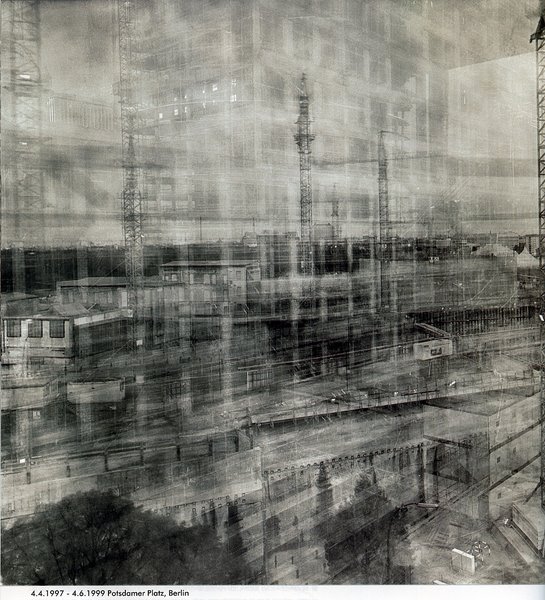
Recently I came across German photographer/artist Michael Wesley's monochromatic photographs that are a part of his open shutter project, which record the image over long periods of exposure sometimes lasting 3 years.
In the past I have also written of Michael Kenna's long exposure photographs in low light conditions giving absolutely stunning high contrast images that beautify the very constraint, the static nature of a photograph. Here the image isnt a split second capture but something that has been and will continue to be. The environments recorded are almost meditative minimal landscapes of silence.

(image sourced from here)
But when a similar methodology gets used in urban environments that attempts to record months of moving images in one frame the result is as magical. Within the greater Order of Things in the branch of still photography I believe it is like discovering dialectically opposite twins.

(image sourced from here)
Michael Wesley's monochrome photographs that continue capturing the image over a period of 2 to 3 years constantly as the glass eye of the camera gazes continuously at one focus and the world around it changes, it instantly transforms into a time machine with its precise control over the speed of light, absorbtion of the memory of the past, experience of the present and dreams of the future on the film. The images thus recorded are as magical as the moving pictures, they record the very ghosts of time, the paths of the sun as it speeds across the horizon, the glare of a glass window on a particuilar day in winter.

(image sourced from here)
I wonder what would it be to have a camera positioned whose exposure time will work through generations, what would one like to focus their eyes on for the next 80 years if they know it will only be their next generation that shall see what it looked like.

Sunday, March 28, 2010

Lebenswelt

I came across works by two very interesting artists last week, Nicolas Moulin who envisages ruins of mega monolithic concrete blocks in a deserted landscape while the other being Hiroyuki Hamada who designs comparatively small, vaguely futurist looking monoliths.


(Some of the many Hiroyuki's tablets that could easily come to be a parts of totem pole of a dystopian space age civilization, whose technological advancement has come at the price of erosion of memory of history and language...where technology is god. Images sourced from: http://acidolatte.blogspot.com/2010/02/hiroyuki-hamada.html?zx=883872d53fad4dd5)
Hiroyuki's artifacts that seem to draw semantic nourishment from manga, minimalism, space debris, Japanese Zen, Buddhism, God particles, Shivalingam, crustaceans, Mars and brush by closely to Nicolas's Béton Brut work that sends roots to Normandy Bunkers, Corbusier, Oplismeno skirodema, Berlin Wall, Moai, Rosetta stone, Noah's Arc etc according to me are not thriving on but are just the opposite. They are soil samples of the very ground that anchors the tree of Being, from where all these references germinate.


(Images of Nicolas Moulin's collages sourced from Vulgare one can also find an online blog recording by the artist and Amanda Crawley Jackson called Beton brut)
The ability of both these artist to have art works that spread roots through history and simultaneously come across as being so basic that it forms a part of Lebenswelt, the very ground of universality which anchors the roots of metaphysics, to be understood in equal ways by every member of the human race is according to me the true essence of their work.
Scale, texture and form, that is all to it, as wise old university stalwarts would put it, which according to me has more truth to it than the combined cacophony that we seem to have inherited from the circus that was post modernism and these two artists working independently in different circles and continents seem to echo just that. The simplicity of works is refreshing and it just looks very very sexy.