Tuesday, July 24, 2007

My Barber

Next to Borivali station, opposite the 240 bus stop there is this 'Bina haircutting salon' where i go. Most of the barbers have been working there ever since i was a kid accompanied by my dad, who would get a haircut just to give me company. I love getting a haircut, it feels like someone just pressed the refresh button or something like that. A lot of things have changed around the salon, with new shops, new products and new hairstyles. But somehow this place stayed unchanged, the white laminate seat for waiting, the shower handles, the designer barber chairs and people working there. The smell of cheap perfume, shaving cream and powder mixing with the spray and everything gets forgiven. These guys are not into styling, they give 3 types of haircut: small, medium and large, working wonders for office goers and people like me who don't like designer French barbers asking which shampoo i use and when, in that peculiarly condescending way thats makes you feel you don't deserve even a single strand of your own hair on your head.

Friday, July 06, 2007

3rd image


This image as Aditya explained was inspired from a photograph taken to record an internal courtyard. It started with Aditya using the tools of perspective and bending them so as to construct an image that showed more of the courtyard, deforming it more than the photograph so as to enable details of not only the court but also the adjacent corridor spaces that abut it, stretching it a little more so as to represent the narrowness of the court, detailing it intensively to hint at multiple narratives contained within the built form. The pencil sketch used existing tools of drafting and detailing, but when overlaid with a concern to show more, got deformed into a fish eye image.
When Ranjit took over painting of the image, he imagined the image in terms of its light, and attempted to represent the light within the court and thereby represent the narrowness, the stale air, the dimly lit corridors, moisture in the air etc. But interestingly when he painted the image he painted it referring to a photograph and so the rendering of the image got influenced by photographic perception of light and not as seen by the human eye, which explains the over exposure at the top or a little out of focus at the bottom.
The asymmetrical sides, slight tilt of the built form and the clothes (in the extreme top left) hanging straight down are some of the planned errors that add to the overall image.

Wednesday, June 27, 2007

Snails

Few days back I saw many snails that had been awakened by the first rains. All moving dreamily making way to their respective single leafed territories, crisscrossing one another, leaving behind silver trails and gently bowing and touching each other with their fleshy antennae, as if following some snail etiquettes. The more polite ones, stopping completely, withdrawing themselves and moving only when the other snail had moved away, sometimes even over them. Being much higher I could see the whole of this newly revealed snail-city with leaves, glass bottles, flies, plants, trees, grass, water puddles and snails, all maneuvering around this moist geography for food and water. The shelter was not a problem, as all were well equipped with huge spirals (made out of some mathematical golden triangles as observed by many important mathematicians), where calcium met tissue, stone and organism fused together to give rise to soft green snail living in an exquisitely designed shell with autobiographical patterns that told stories of changing weather patterns, water availability and snail moods; everyday carefully recorded as a single line of calcium deposit. The dead shells were usually inherited by a very needful crab, insect, fish or a kid. Some more determined ones stayed buried among the sediments, so as to leave behind an imprint of their magnificent fast paced life for a distant future to rediscover their ghosts in coal.

Monday, June 25, 2007

Details


new construction in Khotachiwaadi


Balcony

Khotachiwaadi

Ranjit usually plans his image, patiently drawing and redrawing smaller details of floating muscled bodies, alien landscapes and aging faces. Carefully selecting an idea of the visual, as if cautiously selecting his language and its words that will float in a landscape of distant remoteness. He likes the act of painting, mixing colours, diluting them with water and applying dabs of olive greens, dark reds, greys and browns with patience, meticulously one stroke at a time, he loves painting ‘real’, getting the wood right or showing age of something that has stood the tests of time, with wrinkled faces, chipped plaster, cracked bones, rusting iron and mottled walls. With his strange ideas of layering he tends to build the image up through thin translucent watery layers of paint that get overlapped one over the other, each layer adding a newer detail till the shimmering sunlight in a house galli or concrete angel bracket detail starts looking more real than real itself.
My attempts at getting myself to plan an image have usually resulted in planned failures. I draw and paint at the same time, instinctively deciding colours and technique sometimes even influenced by colour tubes that are within my arms reach. During the course of development most of my images look like colorful studio accidents, but in due course of time I manage to make an image that tries to communicate what we set out to do. I love painting details; I like to divide my canvas into smaller canvas and then each of those into smaller canvases to show a local market, or a heritage police chowki, a pattern of tiles on wall or a cement mixing truck far away. Being lazy to plan and ignorant about the final image I usually have an advantage of evolving the image based on instinctive concerns or even my mood that day, and the painting grows partly based on me and partly itself as if the image has equivalent control over me.

Khotachiwaadi image is a result of collaboration between Ranjit and me. Ranjit has done the Null bazaar buildings on either side that form the housegalli. Through the slit one catches a glimpse of Khotachiwaadi that has been drawn and painted by me. Two distinctly different conditions within the city get represented through our different methods of drawing and painting with Khotachiwaadi being framed by the Null Bazaar housegalli. As Ranjit works at a more zoomed out level, whereas I draw smaller details the painting requires almost two foci to see it, where the observer can focus either on the housegalli or on Khotachiwaadi.

Sunday, June 10, 2007

Saturday, June 09, 2007

First exhibition painting
Me, Ranjit and Pottu have got an opportunity to do a painting and exhibit it at the Project 88 art gallery in Colaba somewhere around Oct-Nov, thanks to Subbu who happened to hear about our work from Paul. We have started conceptualizing and articulating the nature, content of the image and a methodology of collaboration. As three of us collaborate and work on a single canvas the method of collaboration becomes most important part of the decision, as that dominates the image that will emerge in the end. The method decided for this image has worked out well for the multiple city imaginations that we want to talk about as well as the act of collaboration on a single canvas, being ‘tolerant’ of the other individual. Presently keeping all fingers crossed.

Sunday, June 03, 2007

Boy in balcony


The image intends to put the observer within one of the inner city buildings, in a twilight zone, nor out on the street from where you can see the building and not even within one of the houses but somewhere in between, where the no mans land exists or should i say everyone's land. The place where multiple narratives unfold as they co exist in their respective corners, with the building allowing, absorbing and accommodating a range of activities.

The water pumps in lower left hand side corner are peculiar to Null Bazaar where each family has installed its own pump that directly gets connected to the main line which receives water during certain times of the day. As most buildings have turned into a collage of material, activities and spaces services envelope the building and spread in different directions like the water supply pipes that travel within the painting to create spaces. The building internally get figured out such that tolerance and acknowledgement of multiplicity allows people, plants, rats and lizards to coexist each having their own world and role to play within the building.

Thursday, May 10, 2007

Noori

I as a kid never had the experience of going to a baby sitter. But i had Noori. When i was living in peddar road i had to be taken to school (named ‘Activity School’) at 7.30 in the morning and my mum and dad had to get ready and leave for their respective offices. For a long time my parents took turns in fulfilling this responsibility but soon pressures of a kid who didn’t want to get up that early, and if he did, didn’t want to go to school and if he did want to go to school, wanted maggi noodles only in tiffin took its toll. My resistances to ‘the system’ typically got manifested out on the road in full public display, with me being a winning aberration to society. So decision was made (I suspect it was my dad)...even if it is a brief time some one else will send him to school and boldly take up the responsibility of being the epicenter of embarrassment in general ...Noori agreed. Noori was our kachrawalli; with tattoos on her forehead, arms, back and legs enough tattoos to humble a movie-US- prison- inmate (or even one of puffy dee or chucky G or daddy puffies…whoever) and saree smelling of everyone’s kachra. I was never given a chance to caste my vote...veto was out of question. And most importantly Noori was tall, very tall… she was 7 feet tall and i was coming close to a foot (maybe). So for our hands to meet she had to either come down by 2 feet or i had go up by 2...And thus every morning i took flight and floated to school held up 2 feet above ground by Noori.... After a brief period, of a month or so with me unsuccessfully attempting free fall and wrestling techniques, some beyond my physical boundaries, I realized resistance was futile and I surrendered. In due course of time I didn’t mind it and soon I started enjoying my ‘joyride’ to school with Noori, and me hanging on her arm…I could sleep all along the way…without having to worry about the road, traffic, school or life…I was just suspended :)
Presently with all my application process, visa, going abroad, taking loan, paying it back, mortgage, ‘you might just screw up possibilities’, etc, life is so bloody convoluted and complicated that I badly miss Noori who could pick me 2 feet above ground and just dump me to school…taadaaaa!

Saturday, April 14, 2007

Bhiwandi
The Spinning machine
The above photo is a part of the spinning machine, it is a stand on which a certain number of yarn spindles are mounted each contributing a single strand of thread that through elaborate systems of pulleys and hooks that delicately maneuvere each strand from the spindle to the end (right hand side of first photograph) where all the strands converge passing through a small mechanism that is again made of simple wooden pegs and metal rods that does the job of managing each strand and sending it to the desired position in a giant spindle specially prepared for a certain weave. The spindle is usually a drum made of metal or wood (2nd photo) onto which the threads get wrapped around tightly. Now the tough part is that this spindle is loaded onto the weaving machine which again takes each strand and weaves it into the cloth and so it is extremely important that throughout the spindle, it has to have every single strand or else it will give rise to an empty line in the cloth with that particuilar strand absent. A worker explained that in case a strand breaks they stop the machine rejoin the strand and then start the machine again, and this is so important that 'zindagi ka dhaga tootey tho chaltha hai, lekin mishin ka dhaga n tootey'.
Bhiwandi suffers a lot of power cut, power fluctuation, power surge and many other incentive packages provided by our schrizo govt. busy stamping SEZs all over the place, due to this power problems especially surges that are very common the tubelights have known to explode and ruin cloth, spindles or even some machines, till someone came up with the idea of having a bulb put in series with the tube (2nd photo). The bulb soaks the extra power and just glows very brightly for some seconds and in turn protects the tube. In some cases bulbs are also provided as their provide the required warmth for the yarn.

Starch machine
This process is required before the spindles of raw cotton yarn go for weaving so as to increase the strength of the strands and also make them slightly hard. This is a much bigger machine consisting of compartments that hold the starch powder and heat it so that it gets the desired consistency to be applied on the strands. The machine efficiently dips each strand of the spindle and coats it with starch before it is sent onto the drums that you see in the photograph to be dried, cooled and then spun again into the same spindle. This entire process involving coating of strands with starch give rise to a lot of heat, the entire galla was extremely hot with workers working in close proximity to these machines handling boiling hot strands with their bare hands. The floor superviser explained that in most of the labour here in bhiwandi was informal and got hired on a daily basis, but in many cases a workers often takes to a certain process or becomes comfortable with a certain machine and that is when 'aadmi aur mishin ek ho jathe hai'.

Dying machine
The yarn dying is an optional process, depending on what cloth has to be generated. A monochrome cloth is sent for dying after the cloth is woven but if the cloth is to have complex weaves visible from both sides of multicoloured threads then it is necessary that weaving process happens after dying of yarn. The process consists of mounting small spindles on a tray that has perforated vertical rods (as seen in the 1st photo on the left hand side) this tray is put into the dying machine which looks somewhat like a mini boiler (as seen on the right hand side of the 1st photo) that gets filled with a certain coloured dye and then sealed. I am not very sure what the right hand side photo machine does but it is a part of the dyeing process i think. The machine was again taking each strand and coating it with oil, i guess it was like adding finishing touches or something. The owner of this galla happened to tell us that 'Bhiwandi mein koi bhooka nahin sotha hai, sabko kam miltha hai' and explained that he had a strict policy that he employs almost anyone who comes and knocks on his factory gate (for that day).
Bhiwandi as an area has number of small and large gallas some legal and others illegal all working under the informal sector and employing a huge number of informal labour. There is complete absence of planned open spaces or housing for people who work and live here as entire area falls under industrial zone.

Saturday, April 07, 2007

Thursday, April 05, 2007

Profusion of Confusion of Position

Last week we finally got opportunity to show our work to S.P. at his studio in Thane. The studio was located on the 2nd floor of an aging yellow building abutting a narrow vehicular road, narrow enough to reduce vehicular speeds but wide enough to stage different dramas from everyday life, from women buying milk to violent fights. The insides were simple with white tiles (having absolutely no marks of paints) and white washed walls, with a unit having well stacked brushes and paints. Everything neatly arranged almost to the extent that I for sometime imagined that even the colour tubes followed a VIBGYOR sequence. An equally neat library and study cabinet adorned with the past as well as the contemporary on one side and a small kitchen platform on the other side. We started showing our work on the studio floor with every image given its due and discussed patiently in context to our intention, methodology and overall project idea. For the first time we were talking about the ‘FORM’ of the image itself and the position we had to define. Even we haven’t been clear about the nature of images and so we have been constantly referring to them as images and not graphics or paintings or documentation material. If we were to show these images as paintings then the form, balance, skill invested become important. As I was also reading Berger’s Shape of Pocket, I seem to understand what it means…where he explains that horses, lilies, sunflowers, shoes, haystacks as subjects to paint have been commonly painted by number of artist and attempted to ‘map’ the model in its entireness, but it is only those specific horses, lilies, sunflowers, shoes and haystacks that become famous and hold everyone’s attention, where the model and the artist merge as one. Here I think it is not the skill of painting that is stressed but the skill of seeing the model or the object and the rest is rigour. No doubt the ‘CONTEXT’ (What? When? How?) of the art work or anything for that matter does become important, but I feel having been trained to think in a certain way without a context most of us seem to have absolutely no means of assessing anything or being in a position to appreciate an image / text / poetry / play. So whenever we go to any art gallery most of us have a deep urge to understand context of the images and then most images / artists get ‘equaled to’, where except the socio-political context all other layers of beauty often get missed out. In History of Art (I don’t remember the author as there are so many histories of arts written) I remember reading a constant attempt by many artists to get ‘something right’ where what is right is something that is not clearly defined but a number of compositions are tried with different colours that are constantly changed on different sizes, and then a diagonal line or a yellow dab just makes it right. I think it’s similar to the ‘right skew’ concept that most of us architects fetishise or the ‘right proportions’ for that matter. When someone makes a wax sculpture of a Little Ballet Dancer aged 14, I wonder does it really become important to know, Why was it made? Who commissioned it? What is the history of Ballet? Was the girl artist’s friend? Did she start Industrial revolution? In order to appreciate how does she stand (she is made of wax, of recently she was x-rayed to reveal the artists work on her skeleton and his attempts to just make her stand), the surreal scale (of she not being small enough to be looked at as a doll but not even life sized but somewhere cast in an uncomforting scale, where you look at a small girl wearing real ballet costume covered with a layer of wax in a glass cubicle) or her expression with high cheek bones (almost Egyptian) hiding secrets that few have access to. No doubt that she turned even more beautiful as I read more about her and her creator, but I wonder isn’t she beautiful the first time you see her? Does personal liking become the only framework in absence of context, to enjoy a piece of classical music, a painting or a poem?

Sunday, March 04, 2007

4th image, by Ranjit


Work has been going a little slowly, hope we are able to create some kind of framework for making of the images. Like having a brief for every image or some concern around which we construct the images or even carry our site work. But now it will be more fun as we will be collecting data in context to the new lens, new way of seeing that has happened. Even the enquiry into how to draw something, how to represent all the words that we speak, how to simply apply paint over paper is turning out to be quite interesting.

Friday, March 02, 2007

Visit to the Town

Visits to Town have always been beautiful, something about the area that makes me feel happy, and content about the fact that only suburbies like me can enjoy that experience. The visit to town was beautiful, as memories were created and embroidered delicately on shirts and skirts that walked hand in hand that night, sprouting plants, blossoming flowers and ripened fruits, as they changed seasons around us, from warm gallery lights to cold glitzy neons seen on the horizon. The buildings turned into people, some old and ragged while others sage like with experience seen on every wrinkle of their facade, some like the ones along the marine lines reminded me of mukul dressed in pastels with horizontal and vertical stripes unsuccessfully attempting to break the chubbiness of the volume of these cotton candy cuboids, some like the churchgate station building reminded me of an extremely extrovert and talkative classmate i had in 4th standard, and many more buildings turning the entire town landscape into huge giants who had stopped moving like ents and were slowly turning into stones and plants, but still watched traffic and people wiz around them with speeds for reasons which they could not comprehend. I wonder whether it was rude of us to point to these curious giants looking down upon us to describe and show their intricately carved brackets hanging from their smooth armpits, balustrades that formed their rib cages, spires that crowned their balding heads, stained glass that they wore like ornaments. The artwork that claimed to be sincere representation of everything outside (and in some cases inside) was extremely bland as compared to these stone-wood giants that pondered at overtly underdressed people with a generous plaster of makeup and unearthly accents walk towards an art gallery.

Sunday, January 07, 2007

Stone Woman

Happened to read A.S. Byatt’s ‘Stone Woman’ from Little Black Book of Stories, a story of a woman who suddenly finds herself transforming into stone, slowly in the beginning with smoothening of the skin around her navel into a marble like hard surface and then changes that take place all over her, with she having stone thoughts of rumbling and crashing, and feelings and perception of time changing.
I especially relished the descriptions of every crystal, stone, mineral, salt, pearl, rock of her and how the transformation makes her even more beautiful. And as she is transforming into stone her need to find a final resting place where she goes about standing and posing in different town squares, graveyards and many other spaces makes her sound super cute. While reading I could almost imagine ‘stone woman’ with crystals all over her reflecting, refracting light into a million beams and million spectrums all around and making low wind chime sounds while moving.
Fell in love with stone woman big time :)

Saturday, December 09, 2006

On monday we (chitra, pottu, me and ninad) make 2nd year class draft insects for the graphics class. Quiet excited about seeing what specimens we have. Below is an interesting specimen of 'portfolio moth' that has been bugging me since 3 days now.

Sunday, November 12, 2006

3rd soofeer cool image i say !

My favourite image of all the images done till now, this image has been drawn by aditya with details of wooden balustrades, metal pipes, doors, locks, bulbs to the smallest detail and painted by ranjit with renderings of shadows and lights on pink, blue and green walls. Long ruminating discussion have happened on this image....holding it in different angles...and ranjit explaining his seven layer painting technique...and pottu going on detailing even the filament of the bulb...and me wanting a pink sky and rflected pink light to lit up the housegalli....and ranjit being very proud of the rust of the pipe on the blue wall....and we fighting over 'we' all should take equal interest in this endeavour...and ranjit wanting to show the clothes hanging down straight and not according to the perspective....all this is rightly proved by the painting being still incomplete...but we shall overcome...someday.

Wednesday, October 18, 2006

2nd image

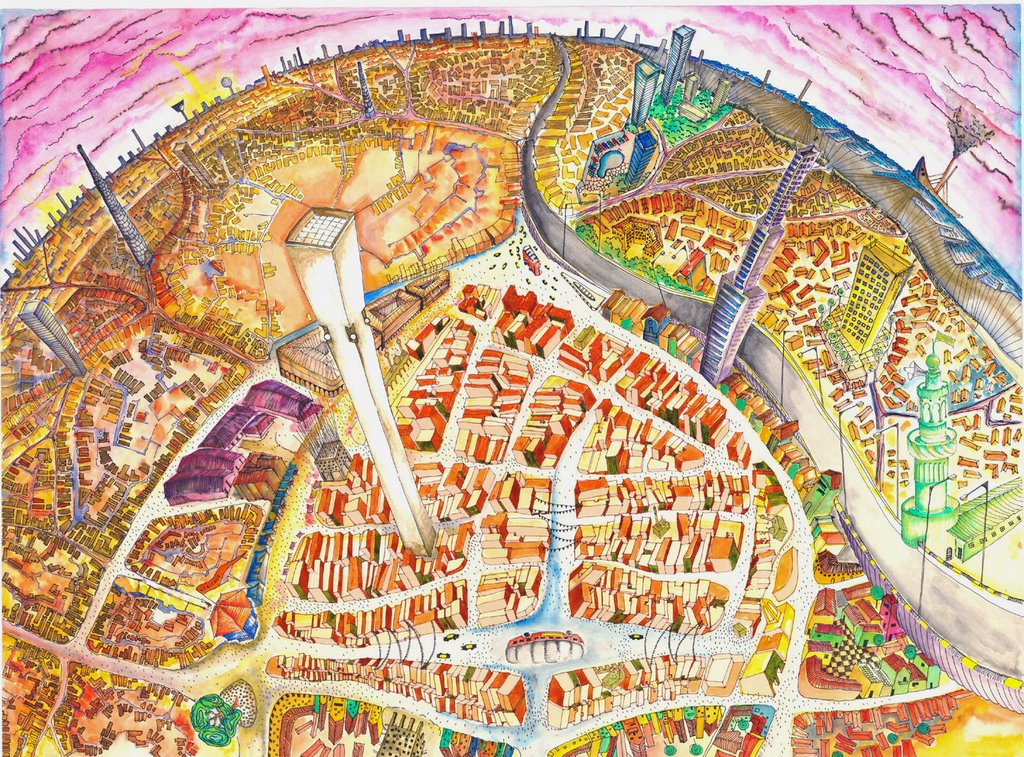
this is the second image, zooming down into one of the streets with the tower from the first painting and small new inserts that have mushroomed within the old fabric due to the opportunities offered by the city that surrounds it...al this against a pink 'Munch-ian' sky.


the image has been mostly worked on by ranjit with me taking certain creative liberties, like my pink sky...but the image still is in process of development...let see...

Friday, October 13, 2006

The power of “WE

My understanding of this complex word, its implications and what it allows has changed a lot lately. Simple but beautiful images from DD metro animations like ‘simi machhli’ or ‘ek a gilahari, anek gilahariyan’ first embedded within my young mind the values of unity, and the power of a collective…with my bed time stories strengthening this naïve concept. From those DD metro animation days to today with George Bush talking about ‘we need to protect our homes from terrorists’ speeches, the word “we” has come a long way in its innovative usages in the English language almost to the extent of replacing most multi lettered words for convenience, blame, appropriation etc…

The word first originated when Neanderthal man created fire and burned down an entire village and exclaimed, “we shouldn’t play with fire” to the survivors (coolly pointing at the charred bodies of the victims).

Also my own personal experiences have taught me to be careful around people who refer to you as “we” for example “we will really have to finish all this by tomorrow”…Reminding me of Sridevi from Mr. India singing “we we we we” as she fools the stupid naïve villains into believing that she is one of them…just as Rajdeep Sardesai and Barkha collect a handful of good performers representing a billion of us and call it “we the people”. I don’t know whether I will ever be able to truly use this beautiful word to its fullest till then the question remains “to we, or not to we”.

Tuesday, September 26, 2006

Null Bazaar painting

The first painting of Null Bazaar : inner city area, a small side project which me, pottu and ranjit have been working on. It hopefully is going to grow into a series of images representing different things which did not find a place in the 33 \ 7 report done in the Design Cell KRVIA. We are not sure of the form yet... but lets see...