new construction in Khotachiwaadi

Balcony
Khotachiwaadi
Ranjit usually plans his image, patiently drawing and redrawing smaller details of floating muscled bodies, alien landscapes and aging faces. Carefully selecting an idea of the visual, as if cautiously selecting his language and its words that will float in a landscape of distant remoteness. He likes the act of painting, mixing colours, diluting them with water and applying dabs of olive greens, dark reds, greys and browns with patience, meticulously one stroke at a time, he loves painting ‘real’, getting the wood right or showing age of something that has stood the tests of time, with wrinkled faces, chipped plaster, cracked bones, rusting iron and mottled walls. With his strange ideas of layering he tends to build the image up through thin translucent watery layers of paint that get overlapped one over the other, each layer adding a newer detail till the shimmering sunlight in a house galli or concrete angel bracket detail starts looking more real than real itself.
My attempts at getting myself to plan an image have usually resulted in planned failures. I draw and paint at the same time, instinctively deciding colours and technique sometimes even influenced by colour tubes that are within my arms reach. During the course of development most of my images look like colorful studio accidents, but in due course of time I manage to make an image that tries to communicate what we set out to do. I love painting details; I like to divide my canvas into smaller canvas and then each of those into smaller canvases to show a local market, or a heritage police chowki, a pattern of tiles on wall or a cement mixing truck far away. Being lazy to plan and ignorant about the final image I usually have an advantage of evolving the image based on instinctive concerns or even my mood that day, and the painting grows partly based on me and partly itself as if the image has equivalent control over me.

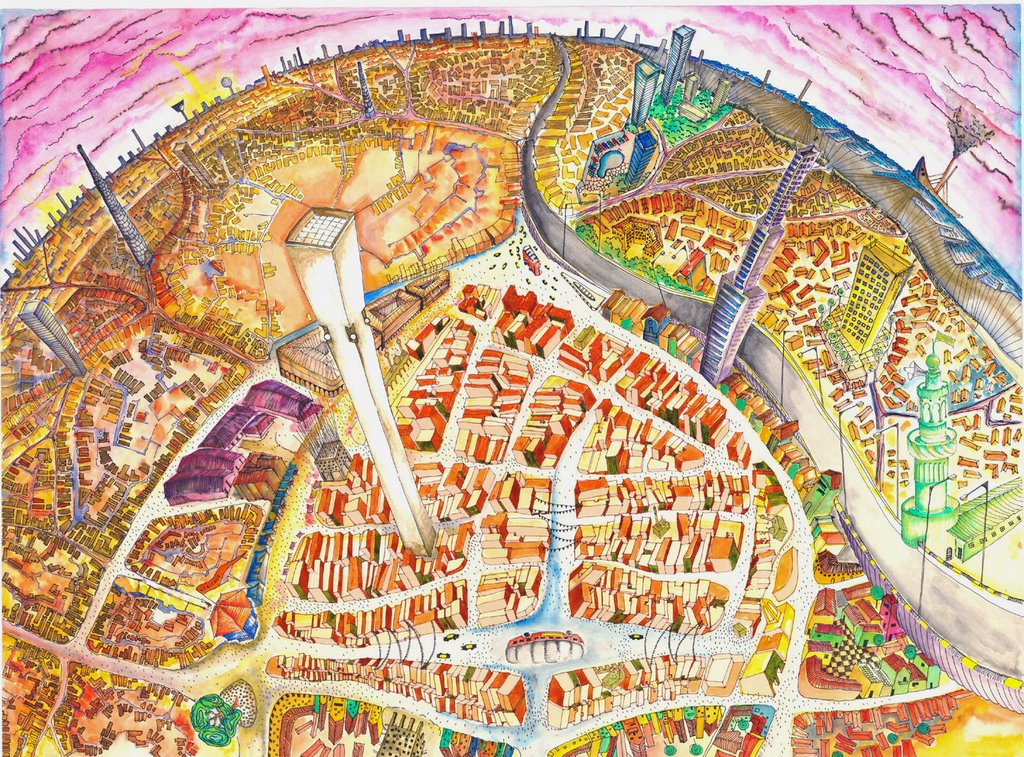
Khotachiwaadi image is a result of collaboration between Ranjit and me. Ranjit has done the Null bazaar buildings on either side that form the housegalli. Through the slit one catches a glimpse of Khotachiwaadi that has been drawn and painted by me. Two distinctly different conditions within the city get represented through our different methods of drawing and painting with Khotachiwaadi being framed by the Null Bazaar housegalli. As Ranjit works at a more zoomed out level, whereas I draw smaller details the painting requires almost two foci to see it, where the observer can focus either on the housegalli or on Khotachiwaadi.

The image intends to put the observer within one of the inner city buildings, in a twilight zone, nor out on the street from where you can see the building and not even within one of the houses but somewhere in between, where the no mans land exists or should i say everyone's land. The place where multiple narratives unfold as they co exist in their respective corners, with the building allowing, absorbing and accommodating a range of activities.
The water pumps in lower left hand side corner are peculiar to Null Bazaar where each family has installed its own pump that directly gets connected to the main line which receives water during certain times of the day. As most buildings have turned into a collage of material, activities and spaces services envelope the building and spread in different directions like the water supply pipes that travel within the painting to create spaces. The building internally get figured out such that tolerance and acknowledgement of multiplicity allows people, plants, rats and lizards to coexist each having their own world and role to play within the building.
Noori
I as a kid never had the experience of going to a baby sitter. But i had Noori. When i was living in peddar road i had to be taken to school (named ‘Activity School’) at 7.30 in the morning and my mum and dad had to get ready and leave for their respective offices. For a long time my parents took turns in fulfilling this responsibility but soon pressures of a kid who didn’t want to get up that early, and if he did, didn’t want to go to school and if he did want to go to school, wanted maggi noodles only in tiffin took its toll. My resistances to ‘the system’ typically got manifested out on the road in full public display, with me being a winning aberration to society. So decision was made (I suspect it was my dad)...even if it is a brief time some one else will send him to school and boldly take up the responsibility of being the epicenter of embarrassment in general ...Noori agreed. Noori was our kachrawalli; with tattoos on her forehead, arms, back and legs enough tattoos to humble a movie-US- prison- inmate (or even one of puffy dee or chucky G or daddy puffies…whoever) and saree smelling of everyone’s kachra. I was never given a chance to caste my vote...veto was out of question. And most importantly Noori was tall, very tall… she was 7 feet tall and i was coming close to a foot (maybe). So for our hands to meet she had to either come down by 2 feet or i had go up by 2...And thus every morning i took flight and floated to school held up 2 feet above ground by Noori.... After a brief period, of a month or so with me unsuccessfully attempting free fall and wrestling techniques, some beyond my physical boundaries, I realized resistance was futile and I surrendered. In due course of time I didn’t mind it and soon I started enjoying my ‘joyride’ to school with Noori, and me hanging on her arm…I could sleep all along the way…without having to worry about the road, traffic, school or life…I was just suspended :)
Presently with all my application process, visa, going abroad, taking loan, paying it back, mortgage, ‘you might just screw up possibilities’, etc, life is so bloody convoluted and complicated that I badly miss Noori who could pick me 2 feet above ground and just dump me to school…taadaaaa!
.jpg)
.jpg) The Spinning machine
The Spinning machine.jpg)
.jpg) Starch machine
Starch machine.jpg)
.jpg) The yarn dying is an optional process, depending on what cloth has to be generated. A monochrome cloth is sent for dying after the cloth is woven but if the cloth is to have complex weaves visible from both sides of multicoloured threads then it is necessary that weaving process happens after dying of yarn. The process consists of mounting small spindles on a tray that has perforated vertical rods (as seen in the 1st photo on the left hand side) this tray is put into the dying machine which looks somewhat like a mini boiler (as seen on the right hand side of the 1st photo) that gets filled with a certain coloured dye and then sealed. I am not very sure what the right hand side photo machine does but it is a part of the dyeing process i think. The machine was again taking each strand and coating it with oil, i guess it was like adding finishing touches or something. The owner of this galla happened to tell us that 'Bhiwandi mein koi bhooka nahin sotha hai, sabko kam miltha hai' and explained that he had a strict policy that he employs almost anyone who comes and knocks on his factory gate (for that day).
The yarn dying is an optional process, depending on what cloth has to be generated. A monochrome cloth is sent for dying after the cloth is woven but if the cloth is to have complex weaves visible from both sides of multicoloured threads then it is necessary that weaving process happens after dying of yarn. The process consists of mounting small spindles on a tray that has perforated vertical rods (as seen in the 1st photo on the left hand side) this tray is put into the dying machine which looks somewhat like a mini boiler (as seen on the right hand side of the 1st photo) that gets filled with a certain coloured dye and then sealed. I am not very sure what the right hand side photo machine does but it is a part of the dyeing process i think. The machine was again taking each strand and coating it with oil, i guess it was like adding finishing touches or something. The owner of this galla happened to tell us that 'Bhiwandi mein koi bhooka nahin sotha hai, sabko kam miltha hai' and explained that he had a strict policy that he employs almost anyone who comes and knocks on his factory gate (for that day)..jpg) Bhiwandi as an area has number of small and large gallas some legal and others illegal all working under the informal sector and employing a huge number of informal labour. There is complete absence of planned open spaces or housing for people who work and live here as entire area falls under industrial zone.
Bhiwandi as an area has number of small and large gallas some legal and others illegal all working under the informal sector and employing a huge number of informal labour. There is complete absence of planned open spaces or housing for people who work and live here as entire area falls under industrial zone.

 I especially relished the descriptions of every crystal, stone, mineral, salt, pearl, rock of her and how the transformation makes her even more beautiful. And as she is transforming into stone her need to find a final resting place where she goes about standing and posing in different town squares, graveyards and many other spaces makes her sound super cute. While reading I could almost imagine ‘stone woman’ with crystals all over her reflecting, refracting light into a million beams and million spectrums all around and making low wind chime sounds while moving.
 My favourite image of all the images done till now, this image has been drawn by aditya with details of wooden balustrades, metal pipes, doors, locks, bulbs to the smallest detail and painted by ranjit with renderings of shadows and lights on pink, blue and green walls. Long ruminating discussion have happened on this image....holding it in different angles...and ranjit explaining his seven layer painting technique...and pottu going on detailing even the filament of the bulb...and me wanting a pink sky and rflected pink light to lit up the housegalli....and ranjit being very proud of the rust of the pipe on the blue wall....and we fighting over 'we' all should take equal interest in this endeavour...and ranjit wanting to show the clothes hanging down straight and not according to the perspective....all this is rightly proved by the painting being still incomplete...but we shall overcome...someday.
The power of “WE”
My understanding of this complex word, its implications and what it allows has changed a lot lately. Simple but beautiful images from DD metro animations like ‘simi machhli’ or ‘ek a gilahari, anek gilahariyan’ first embedded within my young mind the values of unity, and the power of a collective…with my bed time stories strengthening this naïve concept. From those DD metro animation days to today with George Bush talking about ‘we need to protect our homes from terrorists’ speeches, the word “we” has come a long way in its innovative usages in the English language almost to the extent of replacing most multi lettered words for convenience, blame, appropriation etc…
The word first originated when Neanderthal man created fire and burned down an entire village and exclaimed, “we shouldn’t play with fire” to the survivors (coolly pointing at the charred bodies of the victims).
Also my own personal experiences have taught me to be careful around people who refer to you as “we” for example “we will really have to finish all this by tomorrow”…Reminding me of Sridevi from Mr. India singing “we we we we” as she fools the stupid naïve villains into believing that she is one of them…just as Rajdeep Sardesai and Barkha collect a handful of good performers representing a billion of us and call it “we the people”. I don’t know whether I will ever be able to truly use this beautiful word to its fullest till then the question remains “to we, or not to we”.
Happened to see the Airtel advt, with extremely powerful black and white images and sub titles being flashed on your screen… one dream can change a nation (with Martin Luther King), One finger can break a million hearts (with umpire Shepherd declaring Sachin out) and one voice to move a nation two fingers to win a world war and million candles to end it, the add continues, with Gandhi, Mother Teresa, Dalai Lama, Nusrat Fateh Ali Khan and many more doing their bit of modeling for Airtel. The advertisement predictably ends with ‘the power of expression, express yourself’.
Ranjit happened to show me Orkut site and rest of the world on Orkut, right from long lost friends from school days to new potential ones. Everyone can now post pictures, comments, meet friends and have a very delicately crafted profile (with the right light, sepia tone, Photoshop touch ups) all that as we blog, scrap, orkut (don’t know if I can use it as a verb) and form complex communities. So as we continue traveling in packed trains, abusing the government, rushing to our workspaces, negotiating for space and many other everyday torments, we can finally express and declare and say things about the government, rains, poverty, cute puppies, movies and be each others fans and change the world through this new found freedom of expression. We are finally free…
I can’t deprive myself of so much freedom that I never had…
I am on my way to buy an Airtel card, order Adidas shoes, run \ swim to the nearest Reliance centre and open my very own Orkut account.